
Subscribe and receive email notifications of new blog posts.
 RSS Feed
27
Is the Current Housing Market a Bubble?
Is the Current Housing Market a Bubble?

We've been getting a lot of questions recently about whether or not the current housing market is a bubble and if there's a "Great Recession" type crash around the corner. Our team leader, John Yoder, would like to weigh in on this because some of the messaging out there doesn't really add up. In his opinion, the market is not a bubble, though it is problematic. Keep reading to hear why!
Hi everyone! This is John Yoder with Key Realty – John Yoder Team. I'm excited to discuss this topic because I've experienced some different market cycles in the real estate industry. Like so many Americans, I clearly remember the effects of the 2008 recession in terms of property value. I was an investor during this crisis, and learned a lot through the process. I can say from experience and my research on current market conditions, that this market is different than the market in, say, 2007. Though this market presents many challenges, I don't believe it's a bubble.
For starters, let's talk about why today's market feels like 2007. Some of the similarities are striking. We have dramatic price appreciation. The Case-Schiller home price index released on April 27 this year reported a 12% annual price jump in home values nationally for February 2021 compared with February 2020. Knox County is reporting similar numbers with a 10.4% increase in home values in 2020 as compared with 2019.
Homes are selling over appraised value, at times by tens of thousands of dollars and even more in some markets. We have bidding wars and inventory shortages.
This chart shows how inventory has declined over the last year to levels not seen since the early 2000's:

However, the differences are also striking and that is what we want to focus on today.
While we are seeing inventory shortages similar to the early 2000s a key difference is interest rates.

As you can see from this chart, interest rates in '06 and '07 were in the 5-7% range for a 30 year, fixed rate loan. However, today, those rates are right around 3%. That's a huge difference and makes purchasing extremely attractive right now.
This next chart is one of my favorites and helps to show exactly how we got here in terms of housing inventory:
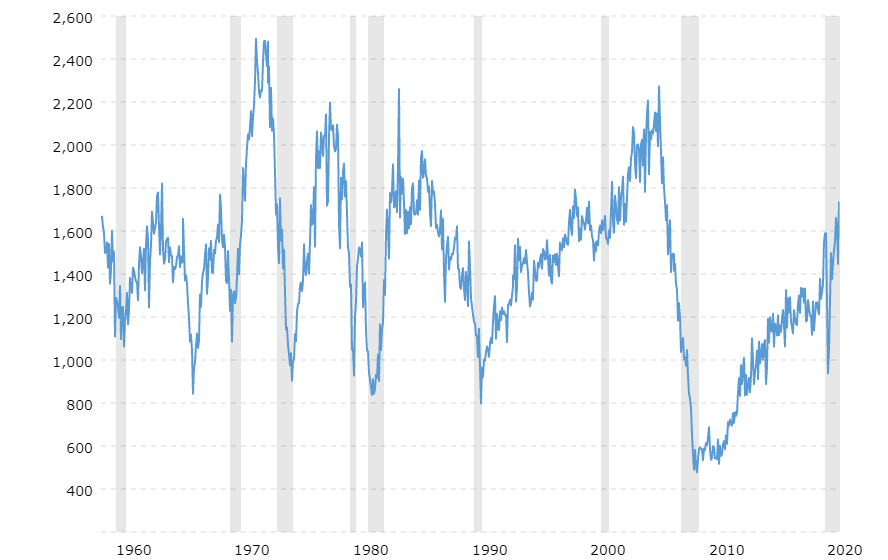
This chart shows home starts, or new construction, from 1959 to present. You can see that from 1959 through 2007 the US averaged over 1.5 million home starts per year. But from 2008 to present, we averaged less than 1 million home starts per year. That's 13 years of under building.
It took some time to absorb the excess inventory coming out of the recession, but now we're faced with a severe housing shortage that probably won't go away any time soon.
Just how bad is our national housing shortage? Sam Khater, Chief Economist for Freddie Mac wrote in an April 15 article that by their estimates, the US is 3.8 million single family homes short of the inventory needed for a balanced market. That number is up 52% from 2018 when Freddie Mac estimated that the national housing shortage was at 2.5 million units.
This increase is surprising in the context of the pandemic and related economic challenges. According to Khater, "A continued increase in housing shortage is extremely unusual; typically, in a recession, housing demand declines and supply rises."*
So what is driving this shortage? Khater says "The main driver of the housing shortfall has been the long-term decline in the construction of single-family homes."As we noted in the home starts chart earlier, building has not fully recovered since the 2008 recession. Commonly cited factors that contribute to underbuilding are lack of available construction labor, land use regulations, zoning restrictions, NIMBYism (not in my back yard), lack of developers and lack of land to develop.
We have seen that both inventory and interest rates are substantially lower than they were in 2007. What other indicators do we have that today's market is structurally sound?
Let's look at loan underwriting. One of the key factors that led to the 2008 recession was easy credit or "no doc loans." Borrowers were able to purchase with little or no money down and very inadequate underwriting. This was combined with predatory loan products. Payments were affordable at first, but jumped significantly after a few years. Many buyers thought it would be easy to refinance when the time came. But market and economic conditions changed and that wasn't possible for many.
Today, we have much stricter underwriting standards and 30-year fixed-rate loans are the norm. Taylor Marr, leading Economist for real estate website Redfin says it well:
"The key difference now versus during the housing bubble before the Great Recession is that back then it was easy credit that fueled speculation, not cheap credit. It wasn't uncommon for buyers to put nothing down and speculate on real estate because all they had to do was fill out a few pieces of paper and no one cared about the actual numbers. This time around the demand that's fueling appreciating prices is real – from families, newly remote workers, and companies relocating employees to lower tax, lower regulation states."**
So if today's housing market is not a bubble, what is the primary cause for concern?
From my perspective, it's affordability, especially for first time home buyers. The Wall Street Journal reported in a May 19 article that the Federal Reserve is starting to signal an eventual move away from easy money policies which would trigger higher interest rates. Higher rates combined with continued price appreciation will start to price some buyers out of the market.
What should you do if you're looking to buy a home and/or to make a difference in the current market imbalance?
First, talk to a lender early in the process. Be prepared to save for a larger down payment than what you originally anticipated.
Second, consider building if you are in a financial position to do so. Our office keeps an updated list of builders with short waiting time.
Third, support responsible, local development across all price points. We all need to do our part to advocate for a more balanced market. A healthy, balanced market helps everyone and provides housing and financial stability to more individuals and families.
We'd love to hear from you, so please leave your thoughts in a comment below!
John Yoder
Key Realty - John Yoder Team
*Source Freddie Mac, freddiemac.com/perspectives/sam_khater/20210415_single_family_shortage.page?
freddiemac.com/research/insight/20210507_housing_supply.page?
**Source: Wall Street Journal, wsj.com/articles/fed-officials-say-they-are-closely-watching-for-right-moment-to-make-policy-shift-11621445379
Additional information for this video provided by Forbes Magazine, April 2021.forbes.com/sites/petertaylor/2021/04/18/yes-americas-housing-market-is-officially-over-heating-everywhere-how-long-can-it-last/?sh=85b2a0244378

|
 |
